

Research ArticleOpen Access, Volume 3 Issue 1
Climate, war conflict and social burden for food and nutritional security in Mali: Impact of local aid efforts
Omar Dao1; Bonkana Maiga1; Mohamed Bilal Aldjou1; Gina Marin; Cloe Marin2; Danini Marin3; Gustavo H Marin2*
1Faculty of Medicine, University Clinical Research Center (UCRC), USTTB, Mali.
2Faculty of Medical Sciences, National University of La Plata, CONICET, Argentina.
3Independent Consultant, Pan American Health Organization Consultant, PAHO, WDC, USA.
*Corresponding author : Gustavo H Marin
Director of CUFAR WHO-PAHO Collaborating Center,
CONICET, Calle 60 & 120 – La Plata (CP 1900), Argentina.
Tel: +54-9-221-5015951;
Email: gmarin2009@gmil.com
Received : Apr 24, 2025 Accepted : May 20, 2025 Published : May 27, 2025
Epidemiology & Public Health - www.jpublichealth.org
Copyright: Marin GH © All rights are reserved
Citation: Dao O, Maiga B, Aldjou MB, Marin G, Marin GH, et al. Climate, war conflict and social burden for food and nutritional security in mali: Impact of local aid efforts. Epidemiol Public Health. 2025; 3(1): 1069.
Abstract
Background: Food insecurity grow in the shadow of social deferment, climate change and war conflicts, all variables that converge in Mali. To determinate food security status & impact of local aid in Mali`s, we performed the present study.
Methods: A description of actual situation in households (after 1 year of international aid), was compared with former evaluation obtained during 2021 using a questionnaire that detect household socio-economic and an anthropometric measurements of house members. The study period was 1-1-2022/1-1-2023.
Results: A total of 340 households were surveyed (2503 members). Male represented 49% (n:1228) and female 51% (n:1275) while 118 pregnant and 217 breastfeeding). International NGO aid and local government support to households obtained an improvement in certain indicators in relation to the baseline measurement surveyed in 2021. This improvement was reflected in the access to drinking water (7 L/day more than 2021) while the water point was located inside the house in 50.1% of households (29.1% in 2021). Food insecurity was 15.6% on average (21.1% in 2021). The strategies followed by households were adapting meals volumes (in 71.2% of households), opting for less expensive food (in 28% of the cases) or transferring the adult food ration to children (19% of the families). 33.3% of households received assistance in the last 6 months (37% food-assistance; 19.7% free-medicines, 16.5 free-money transfer). On contrary, certain economic activities like fishing, drastically drop from 70% in 2021 to 38% in 2022.
Conclusion: Armed conflicts in the north-west region of Mali (circles of Goundam/Timbuktu) have had a negative impact on the quality and living conditions of the inhabitants of the area. Local and international support helped to mitigate the harmful consequences of the war, especially in terms water and food access. Some economic activities that help to sustain households, such as fishing, continue to decline.
Keywords: Food insecurity; Hunger; War; Mali; Aid.
Introduction
In Mali, since 1990, Tuareg and Arab nomads sought independence of Northern region from France during the colonial era, as well as in 1916 during the revolt, and after Mali’s independence in 1960, with heavy military advances in 1963, in the 1990s, in 2006 and in 2012. The Malian army, with the help of the international coalition led by France, fought together, achieving periods of tense calm but failing to achieve a complete peace status in the region [1]. Due to tensions between local and foreign troops, the French military withdrew its forces from the country completely on August 15, 2022, ending its presence in the country [2]. From that time until today, the population living in the circles of Goundam & Timbuktu face a situation of permanent armed conflict between the two factions [3]. Because of this situation, humanitarian access in region was deteriorating rapidly, restricting movement along the main road axes leading to the main towns and other localities of the region, hampering the transportation of essential goods, but also affecting the productive activities that sustain the family economy [4].
In parallel to this political situation, the northern region of Mali is suffering like no other from the consequences of climate change, since it has seen a mean annual increase of 0.7 degrees Celsius in its temperature since 1960 while rainfall has steadily decreased interrupting the seasonal work of pastoralists and farmers, disrupting livelihoods and pushing the population to food insecurity situation [5].
Food security is defined by the Food and Agricultural Organization (FAO) as existing “when all people, at all times, have physical, social and economic access to sufficient, safe and nutritious food that meets their dietary needs and food preferences for an active and healthy life” [6]. In this definition is included all process along the food chain [7,8].
Among the World regions, Africa had the highest per-capita hunger levels according to the Global Hunger Index [9], with more than one in five people classified as undernourished [10-13].
Mali has been facing a multi-sectoral crisis which strongly contributes to the deterioration of the overall food security situation since 2012 [14-19]. This crisis has become all the more accentuated with the recent sanctions imposed on the country by Economic Community of West African States (ECOWAS) and West African Economic and Monetary Union (UEMOA) [20,21]. These sanctions strongly affect the country’s economy and the normal circulation of goods). This situation, in addition to the effects of climatic hazards, mainly observed in northern regions of the country, undoubtedly aggravates food insecurity and negatively impacts the living conditions of households. The deterioration of means livelihood and unusual movements of livestock increase the vulnerability of households, particularly the poorest, to food insecurity [22-26].
Some NGO like ERADD (Equipe Recherche Action pour le Développement Durable), took the initiative of carrying out in Goundam & Timbuktu, a basal assessment of the food security of households [27].
In order to determine the consequences of climate, war conflict and social situation burden in food and nutritional security status of Goundam & Timbuktu Mali`s population in relation to basal data, we performed the present study.
Materials and methods
Type of study
The methodological approach selected for this work is a descriptive diagnosis of households in Goundam & Timbuktu Mali`s regions, that aims to collect the voices and aspirations of community leaders and house members themselves, about their major difficulties they must face to mitigate social and economic problems associated to the local war; and to identify the survival strategies implemented during the last year. These results are compared with data available for year 2021. In order to facilitate the acceptance of data collection agents, local volunteers from different circles territories were recruited on the basis of their experience in carrying out surveys but also of proven knowledge of their own environment and mastery of local languages. They were subsequently trained on the data collection tools and process.
Sampling
The unit of analysis was each household. The sampling of households and individuals to be investigated was determinate by the following formula.
n = N Z2 p (1 – p) / d2 (N – 1) + Z2 p (1 – p)
where n is the sample size, N the total population in the selected area to perform the study, p the expected proportion in the population with food security deficiencies bases on former studies Z is the statistic corresponding to level of confidence according to the standard normal distribution, d=tolerated margin of error The representativeness of this sample is based on the parameters following statistics: 7% margin of error and 95% confidence level (hence z=1.96). In order to grant the same probability of household selection, random sampling approach was used for choice households to be surveyed.
The sample for this evaluation included displaced and host families in the areas selected in the study and Community leaders. The minimum of households to be included was at least 300 in the region.
Data collection tools
Quantitative and qualitative data were collected at the community level in using two types of tools adapted to the national context: o A household questionnaire comprising two (2) parts: A) A socio-economic part, administered to the head of household, which covered the sections relating to the socio-demographic characteristics of the household, housing, household assets and goods, WASH (water, hygiene and sanitation), sources of income, food consumption, sources of supply, aid and assistance. B) An anthropometry part: Anthropometric measurements were taken for every child aged 6 to 59 months (weight, height, upper arm circumference, age) and all men and women pregnant/lactating (weight, height, age), present in households.
Also, community interview (focus group) was performed to 3 groups: 1) Local authorities/neighborhood notables, 2) a group of women (adults) and 3) men. This tool was specially focused on agropastoral and fishery resources, supply and market accessibility, food security prospects, etc.
a) Alimentary consummation: Household food consumption was measured with the Food Consumption Score (FCS) [28] calculated using the following formula:
FCS = a cereal x cereal + a legumes x legumes + a fruit x fruit + a animal x animal + a sugar x sugar + a milk x milk+ a oil x oil
where:
ai = Weight assigned to the food group
xi = Number of days of consumption relating to each food group (≤7 days)
The following Table shows the type and group of food and the recommended weight in the daily diet (Table 1):
Table 1: Food Consumption Score.
| Type of Food | Food group | Weight |
|---|---|---|
| Corn, sorghum, rice, wheat | Cereals and tubers (staplefoods) | 2 |
| Cassava, yam | ||
| Peanuts, legumes(beans, cowpeas, peas,lentils) | Legumes | 3 |
| Vegetables (+leaves) | Vegetables (+leaves) | 1 |
| Fruits (mangoes, bananas, oranges, etc.) | Fruits | 1 |
| Meat, fish,seafood, snails, eggs | Animal proteins | 4 |
| Milk,dairy | Dairy products | 4 |
| Sugar, honey | Sweets | 0.5 |
| Oils and fats | Oils | 0.5 |
| Condiments, spices | Condiments | 0 |
Source: World Food Program
− The values of the scores thus calculated for each household are reported on a scale ranging from 0 to 112. Standard thresholds are used to determine household food consumption classes (poor, borderline, moderately acceptable and acceptable) according to the following score:If FCS<21 the household has poor food consumption;
− If 21< FCS< 35 the household has limited food consumption;
− If 35< FCS < 45 the household food consumption is average acceptable;
− If FCS>45 consumption is acceptable.
Data obtained was compared with the information extracted from National Food Security and Nutrition Surveys performed in 2020 and 2021.
Study coverage areas
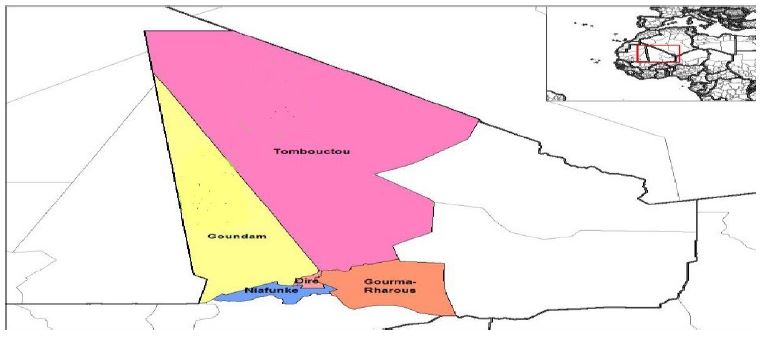
In Mali, the study took place in the circles of Goundam and Timbuktu (Figure 1) more specifically in the municipalities of Timbuktu, Alafia, Aghlal, Bourem-Inaly, Ber, Tonka, Goundam, Kaneye & Mekoreye.
Ethical considerations
Correspondence was sent to the mayors of the municipalities concerned by the study with a view to inform them of the activity but also to obtain their approval for carrying out the evaluation. At neighborhood level, the consent of neighborhood leaders was sought and obtained. Also, a verbal, free and informed consent to participate in the study was requested from each head of household or its representative in case of absence, after an explanation of the objective, the process and evaluation methodology.
Limitations of the study
The insecurity caused by armed groups in the North constituted the major challenge facing the investigation was confronted. Despite this travel restriction, the investigation team adopted alternative strategies, which made it possible to carry out the survey in the target area. Furthermore, the investigation team had to make reasoned choices to take these into account. constraints, particularly in the Goundam circle. This situation led to replacement of certain municipalities not accessible for security reasons by others more accessible communities. The survey period encroached on the lean period agricultural, a period during which populations experience the greatest difficulties in terms of food safety. It should also be noted that this period corresponded at the end of the pastoral lean season. The onset of rains led to flooding in certain areas, limiting access to some selected sites.
Results
A total of 340 households’ referents were surveyed. The number of inhabitants in these homes was 2503 individuals (M: 1228, F: 1275).
Sociodemographic profile
The study sample is composed of 340 households distributed in 09 municipalities (Goundam, Tonka, Kaneye, Mekoreye, Timbuktu, Alafia, Aghlal, Ber & Bourem-Inaly) from the circles of Goundam and Timbuktu.
a) Household status
Analysis of the data collected reveals that 88% of respondents’ households were permanent residents. Internally displaced households represent just under 12%
b) Profile of household heads
Among the households surveyed, 74% were headed by men. Women heads of households represented 26% of respondents. This proportion is significantly higher than the rate observed in ENSAN 2021 which was 10.3% women heads of households. This strong proportion of female heads of households was observed more in the municipalities of Alafia (42%), Kaneye (37%) and Tonka (33%). This increase in the percentage of females as head of households might be related to the fact that the survey had been carried out during the harvest period, where the men are essentially in the fields; and also, that a significant proportion of men in those regions were engaged in radical groups, thus leaving household management to women.
Furthermore, the average age of heads of households was 57 years (higher than that observed during ENSAN 2020, 51 years old) with a minimum of 20 years and a maximum of 88 years. In general, of the 340 heads of households interviewed, 109 (or 32%) did not a minimal educational level. Concerning housing, 74% of households surveyed lived in their own houses compared to 19% living in displaced sites. We also note that 61% of their habitats seem in good condition, 16% in fair condition and 23% in poor condition or partially destroyed. More than 4/5 (84%) of displaced households surveyed, lived in displaced sites while 16% were hosted in other families.
c) Demographic composition of households
The 340 households surveyed included 2503 individuals. Average household size was 7 people (per household). This average was much lower than the national average revealed by ENSAN 2021 which was 9.8. Members of the Men represented 49% of the sample is 1228 men and 51% women (n: 1275 including 118 pregnant and 217 breastfeeding). Children aged 06 to 59 months represented 18.30% of the total workforce (n: 458).
Household living conditions
Water, hygiene and sanitation:
a) Water: Of the households surveyed, 309 (or 91%) had access to an improved water source. Volume of drinking water collected for human consumption at water sources improved from 15 L/day in 2021 to 23.6 L/day in the present. The water point was located inside the house for 50.1% of households (29.1% in 2021); 39.1% of households take less than 30 minutes to get water (round trip + water intake time); between 30 minutes and 1 hour for 8.8% of households. On the other hand, 1.8% of households take between 1 hour and more than 2 hours between the water point and the home (Table 2).
Table 2: Water supply time.
| Water supplytime | Number of households |
|---|---|
| In housing | 171 |
| Less than 30minutes | 133 |
| Between 30 minutes and 1 hour | 30 |
| More than 1 hour | 6 |
b) Lavatory (toilet)
Nearly half of households (54.2%) used common latrines while 9.4% used provide relief directly in nature. Nearly 2/5 of households (36.4%) used a private latrine (Table 3).
Table 3: Lavatory.
| Types of latrines used | Number of households |
|---|---|
| Private latrines | 124 |
| Shared latrines | 184 |
| In nature | 32 |
c) Practice of hand washing with soap
More than four out of five households (81.6%) did not have a specific place reserved for washing hands. Probably remembering past times when access to water was easier, most households had still a good understanding of the importance of washing hands with soap and believed that it was necessary to do so after having had a bowel movement (for 79.6% of households), while cleaning their hands after work (72.3%), before eating or giving food to the child (61.4%) and before preparing food (59.2%).
Breeding:
Livestock ownership: Nearly 2/3 of the households surveyed (65.9%) own livestock. Livestock condition was considered good for 58% of communities and milk production was pointed as good or satisfactory by 68.4% of communities.
Qualitative assessment of breeding conditions: The condition of pastures was considered good by 61.5% of communities and bad/very bad by 38.5%. The pastoral lean season was more difficult because of the insecurity that limited the access to certain pastoral routes. Watering conditions are considered good/satisfactory by 69.2% of communities.
Fishing:
Fish production was considered bad/very bad by 69.2% of the communities. The main causes mentioned were: low reproduction of species (38.6%) and lack equipment for fishermen (32.4%). The main strategies mentioned to deal with the situation were: migration towards unusual fisheries (42.3%) and the development of fish farming (29.5%). This drop in fishing activities was related to the impact of climate change in the region, as well as war situation. The Lake Faguibine system situated in the Tombouctou region in the Goundam cercle, is considered the major ecosystem and the main source of fish for the entire sub-region. The system includes three natural lakes that fill when the Niger River floods, but for several decades, water resources have been in perpetual decline due to the negative effects of climate change and recurring conflict.
Agriculture:
Agriculture was practiced by more than half of the households surveyed (57%). According to gender of the head of household, the proportion of households practicing agriculture is higher among households headed by men (60.3%) than those headed by women (41.4%). The beginning of the current campaign was considered quite good by more than 4/5 of households (81.6%) and 94.2% believed that 2022 campaign was promising compared to the previous years. This continued activity was observed despite the drought of the Lake Faguibine having dried up.
Sources of household income
Livelihoods provided valuable insight into the capabilities, assets and activities that enable households to earn a living to ensure their survival and/or well-being. Small trades (carpenter, masons, plumber, tailor etc.) constitute by far the largest livelihood group with 34.8% of households, followed by food retailing (21.3%), no food (20.4%) and agriculture (18%). More than 2/3 of the households surveyed (70.6%) consider that their current income is insufficient to meet their needs. a). Stability of current income & Evolution (during the last 12 months) of household income: According to 75.3% of households surveyed, their income decreased when it was compared to last year same period. On the other hand, 9.4% of households declare that their income is increasing (most of them belonging to groups that held the power in this region) and 17.3% have stable income compared to the same period of the previous year. b). Constraints weighing on household income-generating activities: Lack or loss of means of production (lack of land/production equipment) (34.2% of households), lack of employment opportunities (34.2%) and insecurity (22.8%) constituted the three main constraints that hindered the income-generating activities of households.
Access to markets
The communities surveyed all have access to at least two markets. The main market was more than an hour’s walk from the village for 61.5% of communities. The second market frequented is more than an hour’s walk away for 73.2% of the communities surveyed. Out data showed that 26% of communities encountered difficulties accessing the main market compared to 34% for the secondary market. Inaccessibility linked to insecurity (32.8%), winter conditions (30.2%). The floods (29.4%) constitute the first three reasons for difficulties in accessing markets main during the three months of rainy season. The availability of cereals and livestock on the markets is judged mostly bad to very bad by the communities (54.3% of communities for cereals and 52.8% for livestock). This situation worsened in the past years due to the escalation of armed clashes in the region.
Household food consumption
Alimentary consummation: Household food consumption was measured with the Food Consumption Score (FCS) described in Materials & Methods section. As a result of applying the formula to the surveyed population, the results of Table 3 were obtained.
The values were calculated using de FCS score applying table 1 values for each household (scale going from 0 to 112). The standard thresholds 28 and 42 were used to determine the three classes of household food consumption: Poor (FCS≤28), Borderline (FCS>28 and FCS≤42) and Acceptable (FCS>42). Results showed that less than 1/5 of the households surveyed (15.3%) had poor consumption levels, while 73.5% had an acceptable FCS food consumption and 11.2% had a borderline FCS score.
Regarding Household dietary diversity it could be said that almost all of the households surveyed declared that they had consumed during the last 24 hours preceding the assessment, cereals (97.6% of households), spices/condiments (97.2%), oils (96.1%) and sugar (94.2%) despite the socio-economic disparities between households. A little less than ¾ of households consumed leaves and vegetables (70.5%); 94% meats and only 48% consumed dairy products. Level fruit consumption was the lowest (22.3% of households). The vast majority (93.8%) of households consumed at least 4 food groups. The number of meals household remains a standard (03 meals) for 88.4% of households.
Nutritional status of pregnant/breastfeeding women and children aged 06 to 59 months
a) Pregnant/lactating women: In the 340 households surveyed, there were 118 pregnant women and 217 breastfeeding women. Age average of these women was 27.3 years old. The prevalence of undernourished (BMI<18.5) among pregnant/lactating women was 17.1%, while 37.8% was overweight/obesity.
b) Children from 06 to 59 months: We counted 458 children aged 06 to 59 months, or 18.30% of the total number of households enrolled. The prevalence of global acute malnutrition (according to the P/T ratio) in these children was 10.4% (slightly higher than the WHO alert threshold: 10%) and 1.7% for moderate acute malnutrition. That of delay growth and underweight were 8.9% and 11.8% respectively.
Coping strategies
The ability of a household to react to difficulties and hazards depends on the level of its natural, material, economic, human, social and political assets, the level of its production, its income, its consumption but also the means at its disposal to diversify your sources of income and consumption in order to mitigate the effects of disasters likely to arise at any time.
a) Dietary coping strategies: Among the households surveyed, 71.2% admitted to use at least one adaptation strategy eating. The three (03) strategies most mentioned by these households were the reduction of meal volumes (41% of households adopting at least one adaptation strategy food), the consumption of less preferred foods because they were less expensive (28%) and the reduction consumption for the benefit of children (19%).
b) Non-food coping strategies: More than 2/3 of the households surveyed (74.7%) adopted at least one adaptation strategy during the survey period. Borrowing money (37% of households adopting at least one non-food strategy), the use of occasional work (21%) and asking for help from the community (14%) were the strategies most mentioned by these households. All households firmed that they usually drop out these strategies when conditions are more favorable.
Assistance and aid programs
During the last 6 months preceding the survey, 33.3% of households received assistance. Households headed by women were more affected by food assistance (37.7%) than those led by men (32.5%). This assistance received mainly concerned free food rations for households (26.4% of cases), health care or free medicines (19.7%) and free money transfer/coupon (16.5%). The main donors were the United Nations Agencies (especially the World Food Program) (52%), Non-Government Organizations (NGOs) (22%), the State (11%) and parents and friends 9%. The three main assistances detected and also the most requested by households were respectively the money transfer/free coupon (91.8% of households), assistance with the creation of new income generating activities (88.3%) and health care or medicines free programs (86.2%).
Food safety
A total of 87.6% households reported a deterioration in the food security situation, and have negative expectations about their future due to the continued rise in food prices and the lack of employment for young people. The agricultural campaign in course nevertheless raises a small wave of optimism among the populations to cope at best to constraints.
Discussion
This paper pretends to describe the local situation of the most of social and economic neglected regions such as those located inside the circles of Goundam and Timbuktu, an area affected by poverty, unfavorable weather conditions and a chronic war situation that is impacting simultaneously in those districts.
All these factors, when integrated into the same territory, make life very difficult for the inhabitants. An example of this is the lack of the basic needs for human being, like food which is considered the most essential element when compared with clothing and shelter, perhaps because is a vital supply that guarantee life for people. “Food security” [29] is a then measure of community’s living standards of life and it depends on several variables like the global market conditions where the international food prices have exponentially increased over the last few years, especially food commodities [30], which includes cereals and dairy products that according with the Agricultural Price Index increased 34% in 2022 compared with 2021 (i.e. price of maize and wheat increased 47% and 42% respectively) [31,32].
As mentioned, previous surveys demonstrated the unfavorable conditions of the population living in Goundam and Timbuktu circles in northern Mali. Based on the results of this work, some changes were observed. For example, the role of women as head members of the households, compared with prior surveys that had 9/1 male/female ratio, significant increase the female role, doubling its initial level of consultation detected in 2020 or 2021; situation that may be related to the enlistment of men in the different factions of the armed conflict.
It can also be seen how some activities, such as agriculture, remained stable, while others have been severely affected during the last year, such as fishing. This might be related to the fact that sand dunes replaced the vast expanses of water from Lake Faguibine the main source of fish. Farming land is irrigated by flooding from the River Niger which is now depending only of a rainy season from July to September (that seems to be enough to sustain the agriculture activities). Hence, usable land is becoming scarce, provoking regular disputes between farmers and livestock herders. People are cutting the last remaining trees, exacerbating soil erosion and dehydration. But for some, there is no alternative if they are to survive.
In relation to the access to water, it could be noticed from the new data reported by our work that it continues to be a problem for 3 out of 10 households, while food markets remain with difficulties to be accessed for 70% of the population, that have to travel more long distances to reach them from their homes.
Periodical monitoring of food and nutritional insecurity is still necessary to measure the impact of the interventions of NGO and Mali`s government initiatives to fight against food insecurity situations northern and central Mali.
This paper demonstrated that those efforts, are able at least in a partially way, to mitigate the severe consequences of climate and unfavorable social conditions in Goundam and Timbuktu circles, aggravated by the armed conflict that was been perpetuated over time in Mali.
Conclusion
The data collected reveal a very worrying situation to the vast majority of households resort to adaptation strategies to cope with the crises they experience. The poor nutritional status of pregnant and lactating women, and children less than 5 years old is alarming compared to the standard thresholds established by the WHO.
Although the living conditions of the homes remains stable compared with previous surveys; the economic activities in northern and central Mali showed a regression due to their conditioning by the climate (increasingly serious droughts or sporadically foods); the perpetuated armed conflict in the area and the unfavorable social conditions of the population.
This study highlights that international and local aid provided by NGO and governments to households, had a positive impact in terms of mitigate the consequences of war and climate change, especially in the creation of new income generating activities in the last years, policies that should not only be maintained but deepened.
Declarations
Author contributions: The following statements should be used “Conceptualization, OD and BM; methodology OD and BM, Data collection; OD and BM; software CM; validation OD GHM, formal analysis GM; investigation OD; writing—original draft preparation, OD; writing—review and editing DM & GHM; visualization CM; supervision MBA, DM; project administration MBA. All authors have read and agreed to the published version of the manuscript.
Funding: Authors funded themselves the present research.
Institutional review board statement: The study was conducted in accordance with the Declaration of Helsinki, and approved by the Ethics Committee FEMBA protocol code 013-21; 10/12/2021.
Informed consent statement: Informed consent was obtained from all subjects involved in the study.
Data availability statement: Data is available in a public, open access repository, accessed by following link: sedici/unlp.edu.ar.
Acknowledgments: Authors thanks ERADD (Equipe Recherche Action pour le Développement Durable) NGO responsible of aid support in Northern Mali households.
Conflicts of interest: The authors declare no conflicts of interest.
References
- Bannelier K, Christakis T. Under the UN Security Council’s Watchful Eyes: Military Intervention by Invitation in the Malian Conflict. Leiden Journal of International Law. 2013; 26: 855-874.
- Le Cam M, In Mali. democracy has been indefinitely postponed. Le Monde. 2024.
- Tobie A, Sangaré B. The impact of armed groups on the populations of central and northern Mali. Stockholm International Peace Research Institute (SIPRI). 2019.
- UN-OCHA. MALI: Blockade in Timbuktu region. United Nations Office for the Coordination of Humanitarian Affairs (OCHA). Flash Report No. 1. 2023.
- Chuteln L. How Climate Change Drives Conflict in Mali. Foreign Policy New. Foreign Policy’s Africa Brief. 2021. Available in: https://foreignpolicy.com/2021/04/28/climate-change-weather-conflict-security-mali/.
- FAO. The State of Food Insecurity in the World 2001. 2002.
- Fanzo J, Haddad L, Schneider K et al. Viewpoint: Rigorous monitoring is necessary to guide food system transformation in the countdown to the 2030 global goals, Food Policy. 2021; 104: 2021.
- Hendriks S, Soussana JF, Cole M, Kambugu A, Zilberman D. Ensuring Access to Safe and Nutritious Food for All Through the Transformation of Food Systems. In: von Braun, J., Afsana, K., Fresco, L.O., Hassan, M.H.A. (eds) Science and Innovations for Food Systems Transformation. Springer, Cham. 2023.
- D’Souza A, Jolliffe D. Conflict, Food Price Shocks, and Food Insecurity: The Experience of Afghan Households. IZA Discussion Paper No. 6621; Bonn, Germany. 2012.
- Arias MA, Ibáñez AM, Zambrano A. Agricultural production amid conflict: separating the effects of conflict into shocks and uncertainty. World Dev. 2019; 119: 165–84.
- Lobal Hunger Index. von Grebmer K, Bernstein J, Geza W, Ndlovu M, Wiemers M, Reiner L, et al. Global Hunger Index: The Power of Youth in Shaping Food Systems. Bonn: Welthungerhilfe (WHH); Dublin: Concern Worldwide. 2023.
- Bentham J, Singh GM, Danaei G, et al. Multi-dimensional characterisation of global food supply from 1961-2013. Nat Food. 2020; 1: 70-75.
- FAO, IFAD, UNICEF, WFP, WHO. The State of Food Security and Nutrition in the World 2021. Transforming Food Systems for Food Security, Improved Nutrition and Affordable Healthy Diets for All FAO, Rome. 2021.
- Leroy JL, Ruel M, Frongillo EA, Harris J, Ballard TJ. Measuring the food access dimension of food security: a critical review and mapping of indicators. Food Nutr Bull. 2015; 36: 167–95.
- Martin-Shields CP, Stojetz W. Food security and conflict: empirical challenges and future opportunities for research and policy making on food security and conflict. World Dev. 2019; 119: 150-164.
- WFP. Gaza on the brink as one in four people face extreme hunger. Food Security Phase Classification report. World Food Programme (WFP) December. 2023.
- Weldegiargis AW, Abebe HT, Abraha HE, et al. Armed conflict and household food insecurity: evidence from war-torn Tigray, Ethiopia. Confl Health. 2023; 17: 1-20.
- Kemmerling B, Schetter C, Wirkus L. The logics of war and food (in)security. Global Food Security. 2022; 33: 100634.
- France 24 News. West African bloc ECOWAS to keep Mali sanctions over delayed elections. 26/03/2022. Available at: https://www.france24.com/en/africa/20220326-west-african-bloc-ecowas-maintains-mali-sanctions-over-delayed-elections
- Europa Press. La UEMOA levanta la suspensión de Malí de sus instituciones, Madrid. 2023. Available at: https://www.europapress.es/internacional/noticia-uemoa-levanta-suspension-mali-instituciones-20230710012817.html
- The Daily Telegraph. Fierce clashes between Malian army and Tuareg rebels kill 47”. The Daily Telegraph. London. 2012.
- Baba Ahmed & Rukmini Callimachi “Islamist group plants flag in Mali’s Timbuktu”. Huffington Post. Associated Press. 2012.
- ENSAN, 2021. FEWS NET. L’insécurité et la hausse des prix limitent l’accès des ménages pauvres aux denrées alimentaires. Famine Early Warning Systems Network. 2021. Available at: https://fews.net/fr/west-africa/mali/mise-jour-sur-la-securite-alimentaire /decembre-2021
- SAID. Baseline Study of the Bureau for Humanitarian Assistance Resilience Food Security Activity in Mali. Final Report. United States Agency for International Development. 2022
- UNICEF. Mali Humanitarian Situation. Report No 12 - January-December 2021. UNICEF, 2022. Available in: https://reliefweb.int/report/mali/unicef-mali-humanitarian-situation-report-no-12-january-december-2021.
- Abdul-Aziz Seidu, Bright Opoku Ahinkorah, Ebenezer Agbaglo, Albert Apotele Nyaaba, Overweight and obesity among women of reproductive age in Mali: what are the determinants?, International Health, 2021; 13, 5: 428–435, https://doi.org/10.1093/inthealth/ihaa094.
- ERADD. Equipe de Recherche-Action pour le Dé veloppement Durable (ERADD) - NGO in Mali. 2023. Available at : https://www.eradd.org/
- World Food Programme (WFP). Food consumption analysis: calculation and use of the Food Consumption Score in food consumption and food security analysis. Technical Guidance Sheet. Rome. 2007.
- Anderson MD, Cook JT. Community food security: Practice in need of theory?. Agriculture and human values. 1999; 16: 141-150.
- Nafees Ahmad, SK Shahnawaz, Muzafar Husain, Sajid Qamar, Zaid Alam. Food Insecurity: Concept, Causes, Effects and Possible Solutions. IAR J Huma Soc Sci. 2021; 2: 105-113.
- Banks AR, Bell BA, Ngendahimana D, et al. Identification of factors related to food insecurity and the implications for social determinants of health screenings. BMC Public Health. 2021; 21: 1410.
- Pruitt SL, Leonard T, Xuan L, Amory R, Higashi RT, Nguyen OK, et al. Who is food insecure? Implications for targeted recruitment and outreach, national health and nutrition examination survey, 2005-2010. Prev Chronic Dis. 2016; 2016: 160103.