

Research ArticleOpen Access, Volume 3 Issue 1
Effectiveness of a breastfeeding promotion program on breastfeeding self- efficacy among primigravid mothers in a North Indian state – A randomized controlled trial
Neha Frederick1*; Lekha Viswanath2; Sanchita Pugazhendi3; Kamli Prakash4; Cindy-Lee Dennis5
1Department of Nursing Sciences, Nursing Officer, Manohar Das Eye Hospital, Prayagraj, India.
2Principal, Amrita College of Nursing, Faridabad, India.
3Principal, Himalayan College of Nursing, Swami Rama Himalayan University, India.
4Vice-Principal, Himalayan College of Nursing, Swami Rama Himalayan University, India
5Professor, Lawrence Bloomberg Faculty of Nursing and the Faculty of Medicine, Department of Psychiatry, University of Toronto, Canada.
*Corresponding author: Neha Frederick
Department of Nursing Sciences, Nursing Officer, Manohar Das Eye Hospital, Prayagraj, Uttar Pradesh, India.
Tel: 7521801968;
Email: neha_joseph60@yahoo.com
Received : May 06, 2025 Accepted : Jun 30, 2025 Published : Jul 07, 2025
Epidemiology & Public Health - www.jpublichealth.org
Copyright: Frederick N © All rights are reserved
Citation: Frederick N, Viswanath L, Pugazhendi S, Prakash K, Dennis CL. Effectiveness of a breastfeeding promotion program on breastfeeding self-efficacy among primigravid mothers in a north Indian state – A randomized controlled trial. Epidemiol Public Health. 2025; 3(2): 1073.
Abstract
Breastfeeding self-efficacy is an important factor that helps improve maintenance of breastfeeding. Studies indicate that if mother is confident in breastfeeding her baby, the longer she can continue to do so. The present study focuses on developing a comprehensive breastfeeding promotion program especially for the primigravid mothers of Uttar Pradesh to boost their confidence regarding breastfeeding.
Materials & methods: A randomized controlled trail was conducted to test the effectiveness of the breastfeeding promotion program on breastfeeding self-efficacy among the primigravid mothers in Prayagraj district of Uttar Pradesh. 100 primigravid mothers (50 in intervention group and 50 in control group) who were within the gestational period of 28 to 34 weeks were selected from the antenatal clinic of a private maternity hospital following the concealed random assignment technique. The samples in the intervention group received the breastfeeding promotion program in two different sessions along with the routine care of the hospital. Each session lasted for 15-20 minutes followed by a follow-up session. The samples in the control group received only the routine care. Both the groups were followed in the postpartum period and the breastfeeding self-efficacy was assessed on third day postpartum.
Results: Significant variations between the groups were discovered (p<0.001) on third day postpartum in relation to self-efficacy in breastfeeding among primigravid mothers. Therefore, it was concluded that the breastfeeding promotion program was very effective.
Conclusion: Breastfeeding is an important step in achieving proper growth and development of the babies. The present study shows that the breastfeeding promotion program is effective in improving the breastfeeding self-efficacy of the primigravid mothers. So, such comprehensive interventions need to be adopted as a measure to promote and improve breastfeeding practices.
Keywords: Breastfeeding promotion program; Breastfeeding self-efficacy; Primigravid mothers.
Introduction
The best way to give a child all the nutrition they need is through breastfeeding. Due to the baby’s ideal growth and development, it benefits both mother and infant [1]. It is crucial to start breastfeeding during the first hour of life, practice exclusive breastfeeding for the first six months of life, and continue it for at least two years along with the proper supplemental feeds [2]. Yet there is delay in initiating breastfeeding within one hour of life [3]. The rate of exclusive breastfeeding is also found to be significantly low in many countries [4,5]. Only 38% infants are being exclusively breastfed worldwide [6]. The rates of continued breastfeeding for up to two years also shows a downfall [7].
Uttar Pradesh (U.P.) is the most populous state in India. In order to meet the Sustainable Development Goal, by 2030, the Neonatal Mortality Rate (NMR) must be significantly reduced in the state [8]. Early breastfeeding initiation and exclusivity is well-known life-saving interventions to reduce the neonatal mortality rate. A well-known life-saving intervention to lower NMR is the early start of breastfeeding and exclusive breastfeeding [9]. Yet U.P. reports only 25% rate of early initiation of breastfeeding [10] and the rate of exclusive breastfeeding also remains to be low 44% [11].
Maternal breastfeeding self-efficacy has been emphasized as a key component for enhancing breastfeeding results [12]. Breastfeeding self-efficacy is basically mother’s confidence in breastfeeding her baby [13]. It is believed that if a mother is confident in breastfeeding her baby, the longer durations of breastfeeding can be observed [14-18]. Antenatal breastfeeding education boosts women’s knowledge, confidence, and abilities to help them become ready for successful breastfeeding.
Mothers’ confidence level regarding breastfeeding her baby could be achieved by good support from the antenatal period. This is necessary for better breastfeeding outcomes. But a gap can be found in the practices of breastfeeding as mothers especially primigravida lack self-confidence and poor knowledge regarding breastfeeding.
A study was conducted to look at the relationship between breastfeeding outcomes and self-efficacy. For this purpose, ten online databases were included that studied the effect of some interventions for mothers on breastfeeding and breastfeeding self-efficacy. It was seen that the mothers in intervention group had higher breastfeeding self-efficacy rates and were more likely to breastfeed as compared to mothers in control groups. Postpartum interventions had significant impact on the breastfeeding outcomes [19].
Apparent gaps have been found in literatures in relation to interventional programs that only focuses on education, counselling and support to antenatal and postnatal mothers. However, no emphasis has been laid on ‘learning by doing’ and motivational aspect to raise the rates of breastfeeding among primigravid mothers in Uttar Pradesh. The Government of India is working hard to bring the rates up but a lot of work needs to be done in sensitizing people regarding breastfeeding. Still many parts of the country are not aware about the breastfeeding benefits and the rate of discontinuation is going higher. Therefore, there is a need to make people aware about breastfeeding with the help of a breastfeeding promotion program.
The breastfeeding promotion program uses multi-component approach including various breastfeeding teaching-learning activities, demonstrations, videos and guide to the primiprimigravid mothers, thereby, helping to improve the breastfeeding self-efficacy and practices of the mothers.
Methodology
The current study has incorporated the Breastfeeding Self-Efficacy Theory that helps to promote the breastfeeding confidence of the primigravid mothers. The literature has proved that one of the most significant factors that can impact mother’s breastfeeding behaviour is breastfeeding self-efficacy [20]. The perceived ability of the mother to breastfeed her child is termed as breastfeeding self-efficacy. According to Dennis’ concept, mother’s intention to breastfeed her child is affected by her breastfeeding self-efficacy as how much effort she puts in and how to tackle the problems of breastfeeding [21].
Exclusive breastfeeding has also been linked to high breastfeeding self-efficacy. As per Dennis’ framework, breastfeeding self-efficacy is an essential aspect in determining the length of time a mother breastfeeds her child because it influences (a) her breastfeeding decision (b) her effort for breastfeeding (c) her thought patterns regarding breastfeeding and (d) her feelings when faced with challenges. The factors that affect breastfeeding self-efficacy are: (a) performance accomplishments (such as past breastfeeding experiences); (b) vicarious experiences (such as observing other women breastfeed); (c) verbal persuasion (such as encouragement from influential others, such as friends, family, and lactation consultants); and (d) physiological reactions (such as fatigue, stress, and anxiety). Therefore, by modifying these sources of self-efficacy knowledge, health professionals can boost in mother’s breastfeeding confidence.
The breastfeeding promotion program has incorporated the breastfeeding self-efficacy theory, WHO and UNICEF guidelines. Thus, it was developed in a systematic manner. The program was a multi-component program designed by the researcher. The main objective of the program was to improve the breastfeeding self-efficacy of the primigravid mothers. It was prepared keeping in mind about the study population. The program consisted of antenatal education on breastfeeding including demonstration of breastfeeding techniques, assessment of breast and correction of nipple problems and postnatal support. The content was translated into local language Hindi for better understanding of the mothers.
A quantitative experimental approach was used to see the influence of the breastfeeding promotion program on breastfeeding self-efficacy among primigravid mothers. The study adopted post-test only control group design. The study was conducted in a private maternity hospital of Prayagraj district of Uttar Pradesh. This hospital was selected based on the weekly census of around 400 mothers in the out-patient department and the delivery rate was around 200 per month. All the primigravid mothers who were within the gestational period of 28-34 weeks and attended the antenatal clinic of the private maternity hospital were selected for the study. The samples were randomized into control and intervention groups by concealed randomization technique. The inclusion criteria were primigravid mothers who were within the gestational period of 28 to 34 weeks and having delivery in the same hospital. The exclusion criteria were primigravid mothers who were suffering from conditions like pre-eclampsia, HIV etc that affect the breastfeeding outcomes; who were diagnosed with fetal congenital anomalies like cleft lip and cleft palate and were having any psychiatric illness.
After obtaining administrative permission, the data was collected from a private maternity hospital in Prayagraj from November 2021 to August 2022. The data included 100 primigravid mothers (50 mothers were in intervention group and 50 mothers were in control group) who were within the gestational period of 28 to 34 weeks following the concealed random assignment technique. Double blind method was used to recruit the samples. The samples in the intervention group received the breastfeeding promotion program in two different sessions along with the routine care. The entire program was covered in two sessions of 1-2 weeks apart followed by one follow-up session and each session lasted for about 20-30 minutes. The breastfeeding promotion program included various audio-visual aids like power point presentation, charts, flip charts and online videos and teaching-learning activities were carried out to help the mothers in gaining confidence in breastfeeding their infants. The control group mothers received only the routine care. Both the groups were followed postnatally and the breastfeeding self-efficacy was assessed on third day postpartum using the Breastfeeding Self-Efficacy Scale -Short Form (BSES-SF).
The self-efficacy of mothers in breastfeeding is measured using the standardized Likert scale. Dennis and Faux developed The Breastfeeding Self-Efficacy Scale-Short Form (BSES-SF) to assess the confidence of the breastfeeding mothers. It is a self-reported Likert scale with 14 items, ranging from 1 (not at all confident) to 5 (extremely confident). Scoring was categorized as 14–28 = Poor self-efficacy, 29–42 = Moderate self-efficacy, 43–56 = Good self-efficacy, 57–70 = Very good self-efficacy.
Results
The background information of the primigravid mothers showed that the mothers in both the groups were homogenous in nature, inferring that the primigravid mothers in both the groups came from the same population. Majority of the mothers in both the groups belonged to the age group of 26-30 years with mean age±S.D. of 26.38±3.64 in the intervention group and 25.66±3.72 in the control group respectively. Regarding maternal education, majority of the mothers had secondary and collegiate education. Most of the mothers in both the groups belonged to Hindu religion, had non-working status and had nuclear family
Comparison of breastfeeding self-efficacy between the intervention and control groups
The distribution of intervention and control group based on breastfeeding self-efficacy is depicted in Figure 1.
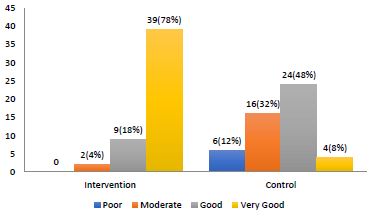
From the above figure 1, it is concluded that on the third day postpartum many primigravid mothers of the intervention group had very good breastfeeding self-efficacy [39(78.0%)] in comparison to control group [4(8.0%)]. Better breastfeeding elf-efficacy was found in the control group [24(48.0%)] than in the intervention group [9(18.0%)]. In comparison to the control group [16(32.0%)], mothers in the intervention group exhibited moderate breastfeeding self-efficacy [2(4.0%)]. While none of the mothers in the intervention group reported low breastfeeding self-efficacy, [6(12.0%)] of the mothers in the control group did.
The breastfeeding self-efficacy scores of the primigravid mothers between the intervention and control groups are presented in Table 1.
Table 1: Self-efficacy scores of primigravid mothers in breastfeeding.
| Groups (n=100) | Maximum Score | Mean±S.D. | Range | Median | Inter-Quartile Range (IQR) | p-value |
|---|---|---|---|---|---|---|
| Intervention | 70 | 57.94±6.01 | 35 - 64 | 60 | 1-57 | < 0.001 |
| Control | 70 | 42.20±9.69 | 22 - 62 | 44 | 47-36 |
Mann Whitney U Test (195.50)
From table 2, it is found that the intervention group median is 60 with inter-quartile range of 61-57 as compared to control group median which is 44 with inter-quartile range of 47-36. Significant variations between the groupings were discovered (p<0.001). Therefore, it is concluded that in comparison to the control group, the intervention group had increased breastfeeding self-efficacy on the third day postpartum period.
Discussion
Many studies have revealed that breastfeeding confidence in the mothers has been identified as a key factor influencing breastfeeding outcomes in later stage. The length of breastfeeding was strongly predicted by the mother’s early postpartum breastfeeding self-efficacy. The findings of this study supported the idea that antenatal breastfeeding guidance can improve the breastfeeding self-efficacy of primigravid mothers. The present study concluded that the breastfeeding self-efficacy among primigravid postnatal mothers was very good in intervention group [39(78%)] than in control group [4(8%)]. In the intervention group, good breastfeeding self-efficacy was found among [9(18%)] mothers while in control group it was [24(48%)] among primigravid mothers. In the intervention group, the moderate self-efficacy for breastfeeding was [2(4%)] compared to [16(32%)] in the control group. Poor breastfeeding self-efficacy was reported by only control group mothers [6(12%)].
A study was done in Shimla, Himachal Pradesh to determine the influence of breastfeeding self-efficacy program on the breastfeeding self-efficacy among 60 primigravid mothers. The study revealed that the experimental group’s level of breastfeeding self-efficacy was much higher than that of the control group [22]. Another study done in China among 74 primigravid mothers revealed that the intervention was effective in enhancing the breastfeeding self-efficacy of mothers [23].
The present also identified a factor which majority of the primigravid mothers believed that they were uncertain or not at all confident about breastfeeding their baby in public, even in the presence or in front of other family members. A study done in Jaipur, Rajasthan also found out that mothers feel that breastfeeding in public is embarrassing and shortage of facilities at workplace also contributes to early cessation of breastfeeding and switching over formula feeds [24].
Conclusion
The present study findings highlighted that there was enhancement of breastfeeding self-efficacy among primigravid mothers after the implementation of the breastfeeding promotion program. The effectiveness of therapies concentrating on enhancing breastfeeding self-efficacy has also been established in research studies to enhance breastfeeding self-efficacy. Self-efficacy in breastfeeding is a crucial component that can improve the breastfeeding practices; hence, more of the studies should focus on self-efficacy interventions. Therefore, mothers should be supported from antenatal period to boost their breastfeeding confidence that can further improve the breastfeeding practices and outcomes.
Disclaimer of liability: The article we submitted is entirely our own and does not represent the official stance of our organization.
References
- Bjarnadottir A. 11 benefits of breastfeeding for both mom and baby. Healthline. 2020. [cited 2025 Jun 12]. Available from: https://www.healthline.com/health/breastfeeding/11-benefits-of-breastfeeding
- Karim F, Masum Billah SK, Chowdhury MAK, Zaka N, Manu A, Arifeen SE, et al. Initiation of breastfeeding within one hour of birth and its determinants among normal vaginal deliveries at primary and secondary health facilities in Bangladesh: A case-observation study. PLoS One. 2018; 13: e0202508.
- World Health Organization. Maternal, newborn, child and adolescent health: Breastfeeding. Geneva: WHO. 2016 [cited 2025 Jun 12]. Available from: http://www.who.int/maternal_child_adolescent/topics/newborn/nutrition/breastfeeding/en/
- World Health Organization. Infant and young child feeding. 2020 [cited 2025 Jun 12]. Available from: https://www.who.int/news-room/fact-sheets/detail/infant-and-young-child-feeding
- Radzyminski S, Callister LC. Mother’s beliefs, attitudes, and decision making related to infant feeding choices. J Perinat Educ. 2016; 25: 18–28.
- Babakazo P, Donnen P, Akilimali P, Ali NMM, Okitolonda E. Predictors of discontinuing exclusive breastfeeding before six months among mothers in Kinshasa: a prospective study. Int Breastfeed J. 2015; 10: 19.
- Ogbo FA, Agho KE, Page A. Determinants of suboptimal breastfeeding practices in Nigeria: evidence from the 2008 demographic and health survey. BMC Public Health. 2015; 15: 259.
- Registrar General and Census Commissioner of India. Sample registration system statistical report 2018. 2018. [cited 2025 Jun 12]. Available from: https://ghdx.healthdata.org/record/india-srs-statistical-report-2018
- World Health Organization, LINKAGES. Infant and young child feeding: a tool for assessing national practices, policies and programmes. Geneva: WHO. 2003 [cited 2025 Jun 12]. Available from: https://apps.who.int/iris/handle/10665/42794
- International Institute for Population Sciences (IIPS), ICF. National Family Health Survey (NFHS-4), 2015–16: India. Mumbai: IIPS. 2017.
- UNICEF. Infant and young child feeding. 2000–2007. [cited 2025 Jun 12]. Available from: http://www.childinfo.org/breastfeeding_countrydata.php
- Dennis CL. Theoretical underpinnings of breastfeeding confidence: a self-efficacy framework. J Hum Lact. 1999; 15: 195–201.
- Blyth R, Creedy DK, Dennis CL, Moyle W, Pratt J, De Vries SM. Effect of maternal confidence on breastfeeding duration: an application of breastfeeding self-efficacy theory. Birth. 2002; 29: 278–84.
- Otsuka K, Taguri M, Dennis CL, Wakutani K, Awano M, Yamaguchi T, et al. Effectiveness of a breastfeeding self-efficacy intervention: do hospital practices make a difference? Matern Child Health J. 2014; 18: 296–306.
- Oliver-Roig A, d’Anglade-González ML, García-García B, Silva-Tubio JR, Richart-Martínez M, Dennis CL. The Spanish version of the Breastfeeding Self-Efficacy Scale-Short Form: reliability and validity assessment. Int J Nurs Stud. 2012; 49: 169–73.
- Otsuka K, Dennis CL, Tatsuoka H, Jimba M. The relationship between breastfeeding self-efficacy and perceived insufficient milk among Japanese mothers. J Obstet Gynecol Neonatal Nurs. 2008; 37: 546–55.
- Aluş Tokat M, Okumuş H, Dennis CL. Translation and psychometric assessment of the Breastfeeding Self-Efficacy Scale-Short Form among pregnant and postnatal women in Turkey. Midwifery. 2010; 26: 101–8.
- Weaver JM, Schofield TJ, Papp LM. Breastfeeding duration predicts greater maternal sensitivity over the next decade. Dev Psychol. 2018; 54: 220–7.
- Brockway M, Benzies K, Hayden KA. Interventions to improve breastfeeding self-efficacy and resultant breastfeeding rates: a systematic review and meta-analysis. J Hum Lact. 2017; 33: 486–99.
- Dennis C-L. Theoretical Underpinnings of Breastfeeding Confidence: A Self-Efficacy Framework. J Hum Lact. 1999; 15: 195–201.
- Dieterich CM, Felice JP, O’Sullivan E, Rasmussen KM. Breastfeeding and health outcomes for the mother-infant dyad. Pediatr Clin North Am. 2013; 60: 31–48.
- Parmar S, Viswanath L. The effectiveness of a breastfeeding self-efficacy programme on breastfeeding self-efficacy and breastfeeding practice among primigravida mothers. Int J Nurs Care. 2019; 7: 69–73.
- Wu DS, Hu J, McCoy TP, Efird JT. The effects of a breastfeeding self-efficacy intervention on short-term breastfeeding outcomes among primiparous mothers in Wuhan, China. J Adv Nurs. 2014; 70: 1867–79.
- Kumawat S. Breastfeeding in public places is a challenge for Indian mothers. In: 3rd International Online Conference on Emerging Trends in Multi-Disciplinary Research. 2022.